At the Kulturhus
Ole Martin Kvalheim's latest exhibition is a staggering meditation on mortality through photographs of discarded umbrellas.
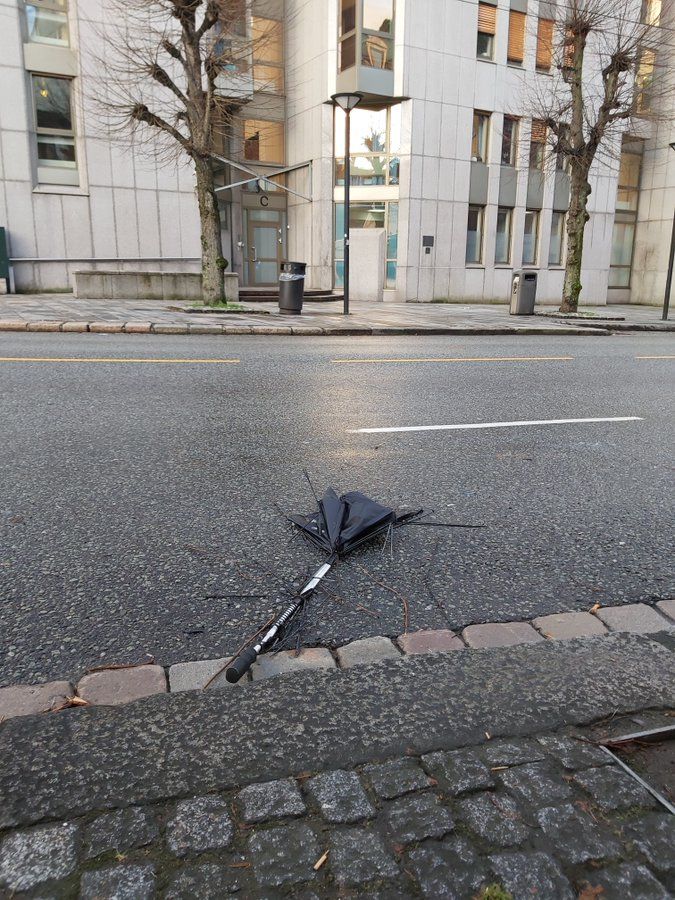
#deadumbrellasofbergen, Ole Martin Kvalheim
In Ole Martin Kvalheim's radical student years, he first came to national attention as one of the authors of the Neo-Nordic street art manifesto Satan i gatan, which declared that "the future of high art is democratic, and all-pervading. Let each street be covered with artwork, and let value be attached to every object."
Kvalheim's determinedly demotic, all-embracing, ever-generous aesthetic recalled, for some, the poetry of Walt Whitman, who wrote that "all men contain something of the artist within them." All streets, Kvalheim could have responded, contain something of artistic value. It seems entirely deliberate that his latest exhibition opens with a quotation from Whitman's 'Starting from Paumanok':
And I will show that whatever happens to anybody it may be turn'd to beautiful results
And I will show that nothing can happen more beautiful than death.
#deadumbrellasofbergen, though, is only in part a meditation on death and dying. Simultaneously, it's a celebratory affirmation of Kvalheim's central credo: the world around us happens to be composed of objets d'art, frequently to be found in the most unexpected locations.
Kvalheim has chosen to decorate his gallery with 2 metre by 2 metre framed photographs of discarded umbrellas on the streets of Bergen, each accompanied by a quotation inviting the viewer to reflect on their mortality. Torn and wind-battered, lonely and no longer fully functional, the umbrellas nevertheless emanate both resilience and beauty. There's a religious dimension to the work of Kvalheim's mature years, and #deadumbrellasofbergen flirts with the idea of an afterlife. Where there's this much beauty to be found, Kvalheim suggests, can death ever really be final? A quotation from Schopenhauer's The World as Will and Representation seems particularly illuminating:
Death is a sleep in which the individual is forgotten: everything else wakes up again, or rather has never slept.
By filling the gallery with images of 'dead' umbrellas, Kvalheim pointedly celebrates the dissolution of the individual into the masses, an almost-alchemic process by which the 'dead' umbrella is permitted to reawake and offered admission to the variety of eternal life offered by representation in art. (When we, the viewers, enter the gallery, the price we pay for a ticket – just 500 NOK – is symbolic of our own entry into the world of the eternal.)
Kvalheim's commitment to democratic populism, meanwhile, has been evident in his shrewd approach to promoting his latest exhibition. A viral social media campaign posted one 'dead' umbrella image per day across a variety of platforms, reaching an audience as far afield as Oslo, and the use of a hashtag in the exhibition title must be regarded as an olive branch to a younger, less-educated audience – an olive branch offered, with typically effusive generosity, by one of the greatest artists of his generation.